- In-Stock Tumor Cell Lines
- Human Orbital Fibroblasts
- Human Microglia
- Human Pulmonary Alveolar Epithelial Cells
- Human Colonic Fibroblasts
- Human Type II Alveolar Epithelial Cells
- Human Valvular Interstitial Cells
- Human Thyroid Epithelial Cells
- C57BL/6 Mouse Dermal Fibroblasts
- Human Alveolar Macrophages
- Human Dermal Fibroblasts, Adult
- Human Lung Fibroblasts, Adult
- Human Retinal Muller Cells
- Human Articular Chondrocytes
- Human Retinal Pigment Epithelial Cells
- Human Pancreatic Islets of Langerhans Cells
- Human Kidney Podocyte Cells
- Human Renal Proximal Tubule Cells
Hair research does not begin with strands or scalp images. It begins at the cellular level.
Behind every phase of the hair cycle—growth, regression, and rest—is a coordinated network of specialized cells within the hair follicle. When examined as a hair follicle under a microscope, this network reveals precise spatial organization rather than random cell aggregation.
Understanding how these cells communicate is essential for moving beyond descriptive observations toward mechanistic insight, particularly when investigating changes in the structure of hair under physiological or pathological conditions.
As interest in hair biology, alopecia, and regeneration continues to grow, researchers increasingly rely on well-defined hair follicle cell models that reflect native structure while remaining experimentally controllable.
The Hair Follicle as a Mini-Organ
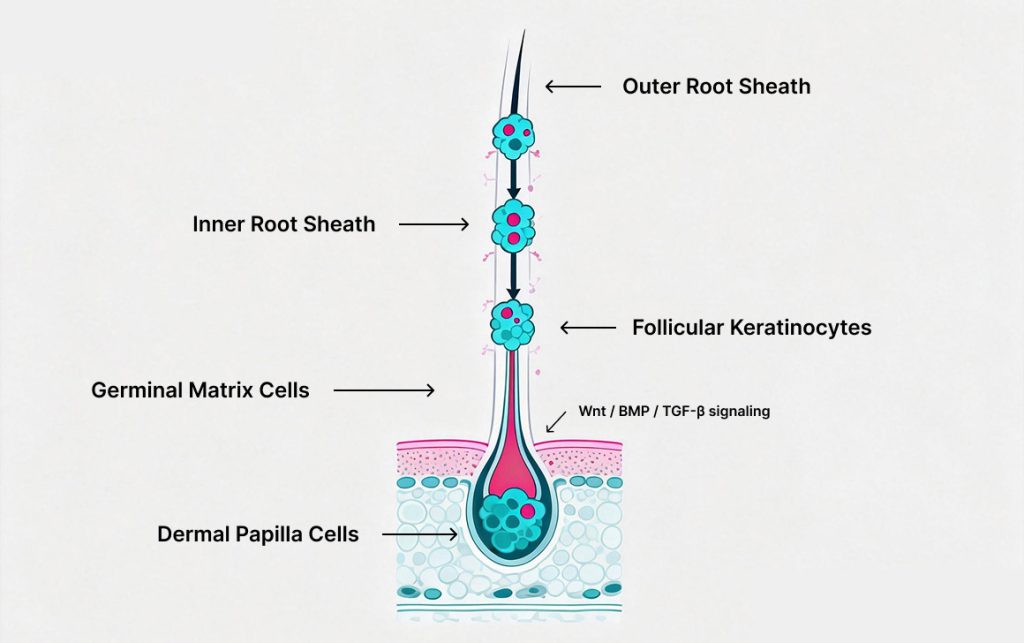
The hair follicle is not a passive skin appendage. It is a dynamic mini-organ composed of epithelial and mesenchymal compartments, each contributing distinct regulatory functions.
At the tissue level, disruptions in follicular organization are often associated with conditions such as damaged hair follicles, where the balance of signaling molecules and the structural integrity of the follicle are compromised.
To study this complexity in vitro, researchers often combine multiple primary cell types that represent different follicular regions. A broad range of such hair-related cell models—including dermal papilla cells, follicular keratinocytes, root sheath cells, and hair follicle stem cells—are now available as standardized research tools
Dermal Papilla Cells at the Core
At the base of the follicle, dermal papilla cells act as regulatory hubs. Rather than producing hair directly, they influence when and how hair is formed by sending signals to surrounding epithelial cells.
In experimental systems, these cells are frequently evaluated in contexts related to hair thickness, cycling activity, and comparative intervention studies, including analyses resembling red light therapy before and after, where cellular responses are assessed rather than cosmetic outcomes.
Human Hair Follicle Dermal Papilla Cells are widely used to study hair cycle regulation, androgen responsiveness, and signaling pathways such as Wnt, BMP, and TGF-β. These cells often serve as the starting point for in vitro hair growth models and compound screening strategies aimed at identifying the best products for hair growth and thickness based on cellular evidence.
Epithelial Cells That Build the Hair Shaft
While dermal papilla cells coordinate follicle behavior, epithelial cell populations execute hair production.
Human Hair Follicular Keratinocytes and Human Hair Germinal Matrix Cells represent key epithelial components responsible for differentiation and rapid proliferation during active hair growth. Alterations in these populations are frequently observed in follicles described as follicular abnormalities in early-stage or informal classifications, prior to precise histological definition.
Studying these cells alongside dermal papilla cells enables researchers to investigate epithelial–mesenchymal interactions that define functional hair follicles.
Inner and Outer Root Sheath Cells: Structure and Interface
Structural integrity and follicle–skin interaction are mediated by root sheath cells.
Human Hair Inner Root Sheath Cells contribute to hair shaft guidance and alignment within the follicle, supporting studies focused on hair fiber formation and follicular architecture. In contrast, Human Hair Outer Root Sheath Cells form the interface between the follicle and epidermis, making them valuable for research involving migration, signaling, and skin–hair interactions.
Together, these cell types help explain how disruptions in follicular architecture can progress from reversible stress to severe follicle dysfunction.
Stem and Progenitor Cells in Hair Research
Beyond differentiated follicular cells, hair follicle stem cells offer insight into long-term regeneration and self-renewal capacity.
Human Hair Follicle Stem Cells, along with animal-derived follicle stem cell models, are increasingly applied in regeneration-focused studies, comparative biology, and exploratory tissue engineering. These models are particularly important for distinguishing between dormant follicles and those often misclassified as dead hair follicles, which in many cases retain latent regenerative potential.
A Cell-Centered View of Hair Biology
Hair growth is governed not by a single signal or cell type but by coordinated decisions within the follicular microenvironment. By integrating multiple hair follicle cell models—such as those in AcceGen’s portfolio—researchers can design experiments that better reflect biological reality. In hair biology, progress begins with choosing the right cells—and understanding their synergy.
Explore AcceGen's portfolio of hair follicle cell models for your research: https://www.accegen.com/search/?q=hair

Copyright - Unless otherwise stated all contents of this website are AcceGen™ All Rights Reserved – Full details of the use of materials on this site please refer to AcceGen Editorial Policy – Guest Posts are welcome, by submitting a guest post to AcceGen you are agree to the AcceGen Guest Post Agreement – Any concerns please contact marketing@accegen.com