



Tumor Cell Lines

A-253

  • For research use only

Cat No.

ABC-TC0024

Product Type

Human Salivary Cancer Cell Lines

Cell Type

Epithelial

Species

Human

Growth Conditions

37 ℃, 5% CO2

Source Organ

Submaxillary Salivary Gland

Disease

Cancer

Product Code

A 253; A253

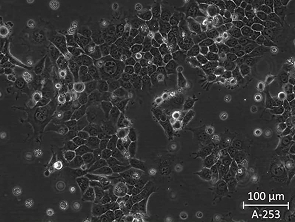
A253: Tumorigenic human salivary gland carcinoma cell line. Epithelial, adherent, near-triploid with 6+ markers.

Product Image

Description

A253 is a human salivary gland carcinoma cell line originally derived from a tumor of the submandibular gland of a 54-year-old Caucasian male. These adherent epithelial cells display a flat, cobblestone morphology and form confluent monolayers in culture. The cell line demonstrates stable growth and expresses characteristic epithelial markers, including cytokeratins. Chromosomal analysis reveals a near-diploid karyotype with chromosomal abnormalities typical of carcinoma cells. A253 cells exhibit intact epithelial junctions and are positive for EGFR, harboring TP53 mutations while retaining wild-type HRAS and NRAS. These properties make A253 a valuable in vitro model for studying the cellular biology and molecular mechanisms of salivary gland carcinoma.

Product Code

A 253; A253

Species

Human

Cat.No

ABC-TC0024

Product Category

Tumor Cell Lines

Size/Quantity

1 vial

Cell Type

Epithelial

Growth Mode

Adherent

Shipping Info

Dry Ice

Growth Conditions

37 ℃, 5% CO2

Source Organ

Submaxillary Salivary Gland

Disease

Cancer

Biosafety Level

1

Storage

Liquid Nitrogen

Product Type

Human Salivary Cancer Cell Lines

Application

  • A253 cells enable cancer research on tumor growth, metastasis, and drug resistance mechanisms while supporting HNSCC drug development through efficacy/toxicity testing. They facilitate cell signaling studies of growth/differentiation/apoptosis pathways and epigenetic research into cancer progression. These cells serve as in vitro models for assessing drug/chemical/radiation effects and studying cellular processes. Additionally, A253 cells advance new HNSCC therapies (e.g., anti-EGFR immunotoxins), evaluate drug resistance mechanisms, investigate cell communication (muscarinic/β-adrenergic receptors), probe tumor metabolism for therapeutic targeting, study laminin-mediated adhesion/differentiation, evaluate sonodynamic therapy’s apoptotic efficacy, and analyze calcium mobilization mechanisms.

Citation

When you publish your research, please cite our product as “AcceGen Biotech Cat.# XXX-0000”. In return, we’ll give you a $200 coupon. Simply click here and submit your paper’s PubMed ID (PMID).

Inquiring A-253

We know how valuable your research is to you, but are you wondering what you can expect to pay for quick accurate results every time? Fill out a request in the form below and we’ll get back to you within 24 hours with a quote.
High Viability
To succeed in cell culture
Precision and Reliability
To support a consistent result
Customization Options
Tailed to your research

Tags

AcceGen Scroll Top Button