



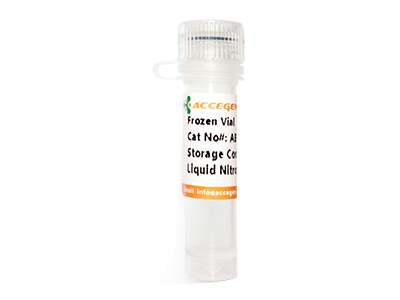
For research use only
| Cat No. | ABI-TC170D |
| Product Type | Immortalized Cell Line |
| Cell Type | Epithelial |
| Species | Human |
| Growth Conditions | 37 ℃, 5% CO2 |
| Source Organ | Eye |
| Disease | Normal |
| Storage | Liquid Nitrogen |
The Immortalized Lens Epithelial Cells - SV40 is established from primary cells using Adl2-SV40 adenovirus.
The Immortalised Lens Epithelial Cells – SV40 is established from primary cells (isolated from infant lens epithelial fragments) using Adl2-SV40 adenovirus. The Immortalised Human Lens Epithelial Cells – SV40 provides a homogeneous population of cell for the investigation of the physiology of the normal human lens epithelium and study its response to cataractogenic agents and the human lens specific functions. These cells also provide a unique system for examining the relationship between gene expression and differentiation.
| Species | Human |
| Cat.No | ABI-TC170D |
| Product Category | Immortalized Cell Lines |
| Size/Quantity | 1 vial |
| Cell Type | Epithelial |
| Growth Mode | Adherent |
| Shipping Info | Dry Ice |
| Growth Conditions | 37 ℃, 5% CO2 |
| Source Organ | Eye |
| Disease | Normal |
| Biosafety Level | 2 |
| Storage | Liquid Nitrogen |
| Product Type | Immortalized Cell Line |
| Immortalization Method | Serial passaging and transduction with recombinant adenovirus carrying SV40 Large T antigen |
| Morphology | Polygonal |
| Quality Control | The Immortalized Human Lens Epithelial Cells react positively with the monoclonal antibody to SV40 large T antigen. Western blot and precipitation are used to confirm the presence of βH- and γ-crystallin, the proteins that are markers for cell differentiation in the lens epithelium. SV40 was observed through IHC (Figure 6). |
When you publish your research, please cite our product as “AcceGen Biotech Cat.# XXX-0000”. In return, we’ll give you a $200 coupon. Simply click here and submit your paper’s PubMed ID (PMID).