



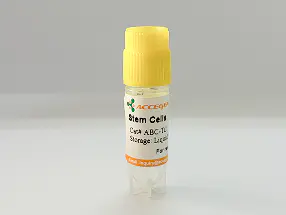
For research use only
| Cat No. | ABC-SC2040 |
| Product Type | Human iPSCs |
| Cell Type | Induced Pluripotent Stem Cell |
| Species | Human |
| Growth Conditions | 37 ℃, 5% CO2 |
| Source Organ | Fibroblast |
| Disease | Epidermolysis Bullosa: Dystrophic, Junctional, Or Simplex Types |
| Storage | Liquid Nitrogen |
HighQC™ Human IPSC From Fibroblast-Epidermolysis Bullosa: Dystrophic, Junctional, Or Simplex Types, ideal for disease modeling and therapeutic research.
HighQC™ Human iPSCs From Fibroblasts–Epidermolysis Bullosa (Dystrophic, Junctional, or Simplex Types) are generated by reprogramming patient-derived dermal fibroblasts obtained from skin tissue. These cells originate from individuals affected by Epidermolysis Bullosa, a group of inherited skin fragility disorders encompassing dystrophic, junctional, or simplex subtypes. They exhibit classical human iPSC morphology, including compact colonies with well-defined borders, a high nucleus-to-cytoplasm ratio, and prominent nucleoli. These iPSCs exhibit pluripotency, with the ability to differentiate into all three germ layers under defined conditions, and express the pluripotency marker SSEA-4. The cells undergo rigorous screening and isolation procedures, and are rigorously tested to ensure they are free of contamination from HIV-1, HBV, HCV, Syphilis, Mycoplasma, Fungi, Yeast, and Bacteria.
| Product Code | HighQC™ Human IPSC From Fibroblast-Epidermolysis Bullosa, HighQC™ hiPSC EB, hiPSC-EB, HighQC™ Human Induced Pluripotent Stem Cells From Fibroblast-Epidermolysis Bullosa |
| Species | Human |
| Cat.No | ABC-SC2040 |
| Product Category | Stem Cells |
| Size/Quantity | 1 vial |
| Cell Type | Induced Pluripotent Stem Cell |
| Growth Mode | Adherent |
| Shipping Info | Dry Ice |
| Growth Conditions | 37 ℃, 5% CO2 |
| Source Organ | Fibroblast |
| Disease | Epidermolysis Bullosa: Dystrophic, Junctional, Or Simplex Types |
| Storage | Liquid Nitrogen |
| Product Type | Human iPSCs |
HighQC™ Human iPSCs From Fibroblasts–Epidermolysis Bullosa (Dystrophic, Junctional, or Simplex Types), also known as Epidermolysis Bullosa iPSCs, provide a robust in vitro research model for investigating the molecular and cellular mechanisms underlying epidermal integrity and skin barrier formation, serving as an EB disease-in-a-dish model. These cells are widely used to study genotype–phenotype relationships associated with different Epidermolysis Bullosa subtypes, including defects in cell–cell and cell–extracellular matrix adhesion, cytoskeletal organization, and basement membrane assembly. Upon directed differentiation into keratinocytes or other skin-relevant lineages, they enable analysis of epidermal development, stratification, and differentiation under disease-relevant genetic backgrounds.
When you publish your research, please cite our product as "AcceGen Biotech Cat.# XXX-0000". In return, we’ll give you a $200 coupon. Simply click here and submit your paper’s PubMed ID (PMID).