



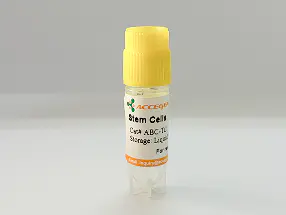
For research use only
| Cat No. | ABC-SC2054 |
| Product Type | Human iPSCs |
| Cell Type | Induced Pluripotent Stem Cell |
| Species | Human |
| Growth Conditions | 37 ℃, 5% CO2 |
| Source Organ | Fibroblast |
| Disease | Long QT Syndrome 3 |
| Storage | Liquid Nitrogen |
Utilize HighQC™ Human IPSC From Fibroblast-Long QT Syndrome 3 for cardiac electrophysiology research, arrhythmia modeling, and drug safety evaluation.
HighQC™ Human IPSC From Fibroblast-Long QT Syndrome 3 is a disease-specific induced pluripotent stem cell line derived from dermal fibroblasts of a donor diagnosed with Long QT Syndrome Type 3 (LQT3), a cardiac arrhythmia disorder primarily caused by mutations in the SCN5A gene. The resulting iPSCs (induced pluripotent stem cells) exhibit adherent growth with a high nucleus-to-cytoplasm ratio. The cells reflect LQT3 cardiac electrophysiology for mechanism research. They retain the fundamental capacity for trilineage differentiation into cell types representing the ectoderm, mesoderm, and endoderm germ layers under defined protocols. These cells express the core pluripotency marker SSEA-4. The cells undergo rigorous screening and isolation procedures, and are rigorously tested to ensure they are free of contamination from HIV-1, HBV, HCV, Syphilis, Mycoplasma, Fungi, Yeast, and Bacteria.
| Product Code | HighQC™ Human IPSC From Fibroblast-Long QT Syndrome 3, HighQC™ hiPSC LQT3, hiPSC-LQT3, HighQC™ Human Induced Pluripotent Stem Cells From Fibroblast-Long QT Syndrome Type 3 |
| Species | Human |
| Cat.No | ABC-SC2054 |
| Product Category | Stem Cells |
| Size/Quantity | 1 vial |
| Cell Type | Induced Pluripotent Stem Cell |
| Growth Mode | Adherent |
| Shipping Info | Dry Ice |
| Growth Conditions | 37 ℃, 5% CO2 |
| Source Organ | Fibroblast |
| Disease | Long QT Syndrome 3 |
| Storage | Liquid Nitrogen |
| Product Type | Human iPSCs |
| Gene Info | Gene: SCN5A; Mutation: ASN406LYS |
HighQC™ Human IPSC From Fibroblast-Long QT Syndrome 3 provides a patient-specific in vitro model for cardiac developmental and disease research. Its pluripotent capacity supports directed differentiation into cardiomyocytes affected by SCN5A mutations. This system enables the study of cardiac action potential prolongation, late sodium current abnormalities, and arrhythmogenic mechanisms, while facilitating drug screening and toxicity evaluation in engineered cardiac tissues or organoid models for channelopathy investigations.
When you publish your research, please cite our product as "AcceGen Biotech Cat.# XXX-0000". In return, we’ll give you a $200 coupon. Simply click here and submit your paper’s PubMed ID (PMID).
Sequencing revealed a de novo missense mutation in exon 10 of the SCN5A gene (1218C>A), located at chromosomal region 3p22.2. The identified mutation is ASN406LYS (N406K), a novel pathogenic variant situated in the IS6 region of the transmembrane-spanning domain of the NaV1.5 cardiac sodium channel encoded by SCN5A.