



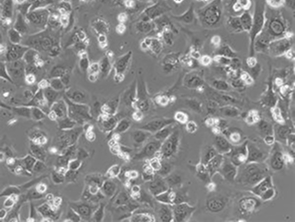

For research use only
| Cat No. | ABI-TC3500 |
| Product Type | Immortalized Cell Line |
| Cell Type | Hepatocyte |
| Species | Human |
| Growth Conditions | 37 ℃, 5% CO2 |
| Source Organ | Liver |
| Disease | Normal |
| Storage | Liquid Nitrogen |
IHH cells are great for quick liver tests. Handle them carefully—avoid repeated freezing and thawing for best results.

Immortalized human hepatocytes are a human liver-derived cell line that was originally established by transducing normal human hepatocytes with the simian virus 40 (SV40) large T-antigen. these cells exhibit adherent growth properties. They retain several hepatocyte-specific functions such as albumin secretion and cytochrome P450 enzyme expression—though at reduced levels compared to primary hepatocytes.
| Species | Human |
| Cat.No | ABI-TC3500 |
| Product Category | Immortalized Cell Lines |
| Size/Quantity | 1 vial |
| Cell Type | Hepatocyte |
| Growth Mode | Adherent |
| Shipping Info | Dry Ice |
| Growth Conditions | 37 ℃, 5% CO2 |
| Source Organ | Liver |
| Disease | Normal |
| Storage | Liquid Nitrogen |
| Product Type | Immortalized Cell Line |
Immortalized hepatocytes simulate primary liver cell functions, making them invaluable in hepatology. They are employed in studies of liver disease mechanisms, drug metabolism, hepatotoxicity testing, and virus-host interactions—especially hepatitis. These cells support functional assays and disease modeling, and they are increasingly explored for cell-based therapies targeting liver failure or injury.
When you publish your research, please cite our product as “AcceGen Biotech Cat.# XXX-0000”. In return, we’ll give you a $100 coupon. Simply click here and submit your paper’s PubMed ID (PMID).
Immortalized human hepatocytes are liver cells that have been genetically modified to proliferate indefinitely. This is typically achieved by introducing specific genes or using viral vectors that prevent the cells from undergoing senescence, thereby allowing continuous cell division and growth. These cells retain many of the functional characteristics of primary hepatocytes, making them valuable for research and therapeutic purposes.
Immortalized human hepatocytes are used extensively in research to study liver function, drug metabolism, and toxicity. They provide a stable and consistent model for investigating hepatic diseases, including hepatitis and liver cancer.
Prolonged Lifespan: They can be cultured for extended periods, providing a consistent and renewable cell source.
Liver-Specific Functions: They retain many characteristics of primary hepatocytes, such as enzyme activity related to drug metabolism.
Reproducibility: Their continuous growth allows for reproducible experiments and large-scale studies.