



For research use only
| Cat No. | ABC-TC0559 |
| Product Type | Human Esophageal Cancer Cell Lines |
| Cell Type | Epithelial-like |
| Species | Human |
| Growth Conditions | 37 ℃, 5% CO2 |
| Source Organ | Esophagus |
| Disease | Esophageal Squamous Cell Cancer |
| Product Code | KYSE 180; KYSE-180; Kyse180; KY180 |
KYSE180 cell line provides a consistent esophageal carcinoma model for signaling pathway studies, gene function, and drug discovery research.
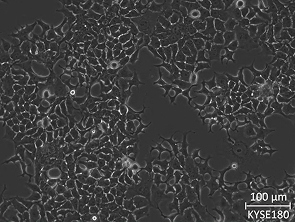
KYSE180 is a human esophageal squamous cell carcinoma (ESCC) line established from a well-differentiated stage III tumor, resected from the mid-thoracic esophagus of a 53-year-old Japanese male prior to treatment. These epithelial-like cells grow as an adherent monolayer. Karyotype analysis reveals a hyperdiploid state, characterized by frequent chromosomal gains (chromosomal gains on chromosomes 1, 3, 7, 8, and 16) and losses (chromosomal losses on chromosomes 14, 17, and 18), along with cyclin D1 amplification and TP53 mutations. Genomic sequencing studies have also identified mutations in NRF2 signaling pathway and occasional HRAS G12S alterations in resistant sublines, highlighting its genomic instability. KYSE180 is tumorigenic when xenografted into immunodeficient mice, making it a valuable model for in vivo ESCC research. The cells undergo rigorous screening and isolation procedures, and are rigorously tested to ensure they are free of contamination from HIV-1, HBV, HCV, Syphilis, Mycoplasma, Fungi, Yeast, and Bacteria.
| Product Code | KYSE 180; KYSE-180; Kyse180; KY180 |
| Species | Human |
| Cat.No | ABC-TC0559 |
| Product Category | Tumor Cell Lines |
| Size/Quantity | 1 vial |
| Cell Type | Epithelial-like |
| Growth Mode | Adherent |
| Shipping Info | Dry Ice |
| Growth Conditions | 37 ℃, 5% CO2 |
| Source Organ | Esophagus |
| Disease | Esophageal Squamous Cell Cancer |
| Biosafety Level | 1 |
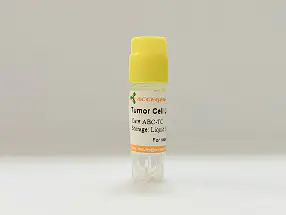
| Storage | Liquid Nitrogen |
| Product Type | Human Esophageal Cancer Cell Lines |
| Stock | Out of stock |
KYSE180 serves as a robust model for studying ESCC tumorigenesis, invasion, and treatment resistance. It has been instrumental in studies dissecting radioresistance mechanisms via single-cell transcriptomics and FGFR2-driven proliferation, migration, and invasion in vitro and in vivo. Researchers also employ KYSE180 to evaluate novel therapeutics such as telmisartan, which induces S-phase arrest in ESCC lines, and to investigate oncogenes like MYH9 that mediate metastasis through angiogenesis and epithelial-mesenchymal transition (EMT) pathways.
When you publish your research, please cite our product as “AcceGen Biotech Cat.# XXX-0000”. In return, we’ll give you a $200 coupon. Simply click here and submit your paper’s PubMed ID (PMID).