




For research use only
| Cat No. | ABL-TC0554 |
| Product Type | Human Leukemia Cell Lines |
| Species | Human |
| Growth Conditions | 37 ℃, 5% CO2 |
| Source Organ | Peripheral Blood |
| Product Code | PL21 |
PL-21 cells serve as a model of human acute promyelocytic leukemia, useful for hematopoietic malignancy research and chemotherapeutic sensitivity testing.
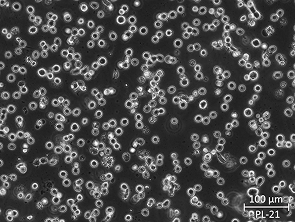
PL-21 is a human acute promyelocytic leukemia (APL) cell line, classified under FAB M3 subtype, it was derived from the peripheral blood of a 24-year-old male patient. The cells grow in suspension and exhibit a typical promyelocytic morphology characterized by large, round to oval nuclei with prominent nucleoli and scant cytoplasm. Unlike typical APL lines, PL-21 lacks the classic APL-associated t(15;17) translocation, making it a distinctive model for studying non-canonical APL pathways. PL-21 cells grow in single-cell suspension, display features of immature nuclei and prominent cytoplasmic azurophilic granules. They exhibit monocytic differentiation profile, confirmed by the strong expression of surface markers CD14/CD68 and the presence of monocyte-specific esterase. PL-21 lacks lymphoid characteristics and is EBNA-negative. PL-21 cells are tumorigenic when implanted in immunocompromised mice, modeling AML pathophysiology effectively. Its capacity makes it particularly valuable for investigating non-canonical APL pathways.
| Product Code | PL21 |
| Species | Human |
| Cat.No | ABL-TC0554 |
| Product Category | Tumor Cell Lines |
| Size/Quantity | 1 vial |
| Shipping Info | Dry Ice |
| Growth Conditions | 37 ℃, 5% CO2 |
| Source Organ | Peripheral Blood |
| Biosafety Level | 1 |
| Storage | Liquid Nitrogen |
| Product Type | Human Leukemia Cell Lines |
PL-21 cell line serves as a unique and versatile model in leukemia research, particularly for exploring non-classical APL mechanisms. It provides excellent platform for studying myeloid cell proliferation and differentiation mechanisms. Additionally, researchers have employed PL-21 cells to investigate the roles of key oncogenic drivers such as p53, FLT3, and KRAS, offering critical insights into their involvement in leukemogenesis and therapeutic resistance. Due to its distinct genetic and phenotypic profile, PL-21 is highly suitable for drug screening, molecular pathway analysis, and the development of targeted treatments for atypical forms of AML and APL.
When you publish your research, please cite our product as “AcceGen Biotech Cat.# XXX-0000”. In return, we’ll give you a $200 coupon. Simply click here and submit your paper’s PubMed ID (PMID).