



For research use only
| Cat No. | ABC-TC0034 |
| Product Type | Human Sarcoma Cell Lines |
| Species | Human |
| Growth Conditions | 37 ℃, 5% CO2 |
| Source Organ | Muscle |
| Disease | Ewing sarcoma |
| Product Code | A673; RMS 1598; RMS1598 |
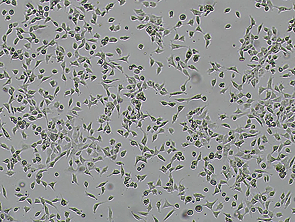
A-673 Ewing sarcoma cells from 15-year-old female show fibroblast morphology,t(11;22) translocation,tumorigenic,metastatic,ideal for tumor microenvironmen.
A-673 is a human Ewing sarcoma cell line originally isolated from the muscle tissue of a 15-year-old female patient. This adherent cell line displays a polygonal morphology and proliferates as a monolayer in culture. A-673 harbors a complex karyotype, including multiple marker chromosomes, an extra F chromosome, and the hallmark t(11;22)(q24;q12) translocation, which is characteristic of Ewing Sarcoma. A-673 demonstrates strong tumorigenic and metastatic potential, forming colonies in soft agar and developing metastatic lesions when xenografted into SCID mice models. The cell line exhibits heightened susceptibility to human adenovirus infection and secretes both oncogenic growth factors and growth-inhibitory molecules, providing a balanced model for studying tumor microenvironment interactions.
| Product Code | A673; RMS 1598; RMS1598 |
| Species | Human |
| Cat.No | ABC-TC0034 |
| Product Category | Tumor Cell Lines |
| Size/Quantity | 1 vial |
| Growth Mode | Adherent |
| Shipping Info | Dry Ice |
| Growth Conditions | 37 ℃, 5% CO2 |
| Source Organ | Muscle |
| Disease | Ewing sarcoma |
| Biosafety Level | 1 |
| Storage | Liquid Nitrogen |
| Product Type | Human Sarcoma Cell Lines |
A-673 cell line provide a versatile platform for studying the molecular and cellular mechanisms underlying Ewing sarcoma. These cells are extensively used in development of xenograft tumor models, enabling the study of tumor progression, angiogenesis, and metastatic behavior. Additionally, A-673 cells are instrumental in evaluating the efficacy of novel anti-cancer agents, particularly those targeting tumor vasculature or growth pathways. Their dual expression of oncogenic and inhibitory factors makes them ideal for dissecting the balance between tumor stimulation and suppression within the tumor microenvironment, facilitating advancements in targeted therapies for Ewing’s Sarcoma.
When you publish your research, please cite our product as “AcceGen Biotech Cat.# XXX-0000”. In return, we’ll give you a $200 coupon. Simply click here and submit your paper’s PubMed ID (PMID).