



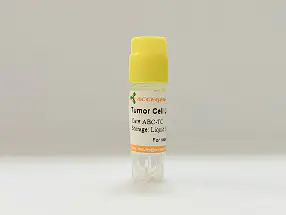
For research use only
| Cat No. | ABC-TC0092 |
| Product Type | Human Melanoma Cell Lines |
| Cell Type | Epithelial |
| Species | Human |
| Growth Conditions | 37 ℃, 5% CO2 |
| Source Organ | Skin |
| Disease | Amelanotic Melanoma |
| Product Code | C-32; C32-mel; C32 mel; C32r |
Human amelanotic melanoma. C32 belongs to the C32r type cultures with the marker M2r substituting the original ring marker M2R. Tumours can be produced in nude mice after 1-2 months (1,000,000 cells injected).
C32 is a human amelanotic melanoma cell line derived from the skin of a 53-year-old Caucasian male patient. These cells display epithelial, fibroblast-like morphology and grow adherently in melanoma culture conditions. Cytogenetic analysis reveals a near-haploid karyotype with a modal chromosome count of 45 in 80-90% of cells. C32 cells carry inactivation of tumor-suppressor CDKN2A/p16 and are deficient in hypoxanthine-guanine phosphoribosyltransferase (HGPRT)—a trait selected during the development of the related C32TG subline using 6-thioguanine resistance. They lack melanin production, reflecting their amelanotic phenotype. When cells are inoculated subcutaneously into nude mice, reproducible tumour growth develops within 1-2 months. The cells undergo rigorous screening and isolation procedures, and are rigorously tested to ensure they are free of contamination from HIV-1, HBV, HCV, Syphilis, Mycoplasma, Fungi, Yeast, and Bacteria.
| Product Code | C-32; C32-mel; C32 mel; C32r |
| Species | Human |
| Cat.No | ABC-TC0092 |
| Product Category | Tumor Cell Lines |
| Size/Quantity | 1 vial |
| Cell Type | Epithelial |
| Growth Mode | Adherent |
| Shipping Info | Dry Ice |
| Growth Conditions | 37 ℃, 5% CO2 |
| Source Organ | Skin |
| Disease | Amelanotic Melanoma |
| Biosafety Level | 1 |
| Storage | Liquid Nitrogen |
| Product Type | Human Melanoma Cell Lines |
C32 cells are ideal for in vitro modelling of melanoma biology in the absence of melanin pigmentation. They have been extensively used to elucidate intracellular signalling mechanisms, including PLC-PKC-MEK-ERK and PI3K cascades, particularly in response to stimuli such as inosine. Moreover, cytotoxic studies with phenothiazines derivatives (e.g., perphenazine and prochlorperazine) have revealed cytotoxic effects, including inhibition of viability, motility, MITF expression, and tyrosinase activity, providing insights into anti-metastatic strategies in amelanotic melanoma. This line supports research into tumourigenicity, apoptosis, migration, and drug screening assays.
When you publish your research, please cite our product as “AcceGen Biotech Cat.# XXX-0000”. In return, we’ll give you a $200 coupon. Simply click here and submit your paper’s PubMed ID (PMID).