



For research use only
| Cat No. | ABC-TC0107 |
| Product Type | Human Kidney Cancer Cell Lines |
| Cell Type | Epithelial |
| Species | Human |
| Growth Conditions | 37 ℃, 5% CO2 |
| Source Organ | Kidney |
| Disease | Renal Cell Cancer |
| Product Code | CaKi-2; caki-2; CAKI 2; Caki 2; Caki2; CAKI2 |
Established from the primary renal carcinoma of a 69-year-old man
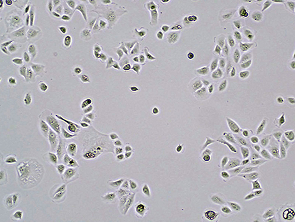
CAKI-2 is a human renal cell carcinoma (RCC) cell line originally established from a skin metastasis of a 69-year-old Caucasian male patient diagnosed with clear cell renal carcinoma. This cell line exhibits an epithelial-like morphology, forming adherent, cobblestone-like monolayers in culture. CAKI-2 is chromosomally aneuploid, with a modal chromosome number of 68-74 and exhibits structural abnormalities consistent with renal tumor origin. Unlike its counterpart CAKI-1, CAKI-2 lacks metastatic potential in nude mice, making it particularly useful for modeling localized RCC biology. Gene expression analysis shows that CAKI-2 expresses epithelial markers such as E-cadherin, along with kidney-specific transporters and differentiation markers, supporting its utility in renal epithelial biology. The cells undergo rigorous screening and isolation procedures, and are rigorously tested to ensure they are free of contamination from HIV-1, HBV, HCV, Syphilis, Mycoplasma, Fungi, Yeast, and Bacteria.
| Product Code | CaKi-2; caki-2; CAKI 2; Caki 2; Caki2; CAKI2 |
| Species | Human |
| Cat.No | ABC-TC0107 |
| Product Category | Tumor Cell Lines |
| Size/Quantity | 1 vial |
| Cell Type | Epithelial |
| Growth Mode | Adherent |
| Shipping Info | Dry Ice |
| Growth Conditions | 37 ℃, 5% CO2 |
| Source Organ | Kidney |
| Disease | Renal Cell Cancer |
| Biosafety Level | 1 |
| Storage | Liquid Nitrogen |
| Product Type | Human Kidney Cancer Cell Lines |
CAKI-2 is frequently used in renal cancer research to study epithelial differentiation, RCC progression, and therapeutic responsiveness. Its non-metastatic nature makes it ideal for modeling early-stage clear cell RCC, enabling preclinical evaluation of targeted therapies, including tyrosine kinase inhibitors. It also serves as a valuable tool in pharmacogenomics, molecular pathway analysis (e.g., HIF-1α and VHL), and nephrotoxicity screening for kidney-specific compounds.
When you publish your research, please cite our product as “AcceGen Biotech Cat.# XXX-0000”. In return, we’ll give you a $200 coupon. Simply click here and submit your paper’s PubMed ID (PMID).