



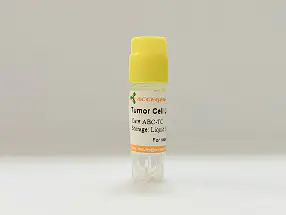
For research use only
| Cat No. | ABC-TC0200 |
| Product Type | Monkey Kidney Cell Lines |
| Cell Type | Fibroblast |
| Species | Cercopithecus Aethiops |
| Growth Conditions | 37 ℃, 5% CO2 |
| Source Organ | Kidney |
| Product Code | Cv-1; CV 1; CV-1.K; CV1 |
Monkey African Green kidney fibroblast. Used in RSV transformation studies.
CV-1 is a non-human primate cell line derived from the kidney of an adult male African green monkey (Chlorocebus sabaeus) and was established in 1964 by Jensen et al. for studies on Rous sarcoma virus (RSV) transfection. This cell line exhibits a fibroblast-like morphology and grows as an adherent monolayer in culture. This kidney-derived cell line exhibits a pseudodiploid karyotype with a chromosome count of 2n = 60, indicating near-diploid content but with structural or numerical chromosomal abnormalities. Each lot undergoes rigorous screening and isolation procedures, and is rigorously tested to ensure it is free of contamination from Mycoplasma, Fungi, Yeast, and Bacteria.
| Product Code | Cv-1; CV 1; CV-1.K; CV1 |
| Species | Cercopithecus Aethiops |
| Cat.No | ABC-TC0200 |
| Product Category | Tumor Cell Lines |
| Size/Quantity | 1 vial |
| Cell Type | Fibroblast |
| Growth Mode | Adherent |
| Shipping Info | Dry Ice |
| Growth Conditions | 37 ℃, 5% CO2 |
| Source Organ | Kidney |
| Biosafety Level | 1 |
| Storage | Liquid Nitrogen |
| Product Type | Monkey Kidney Cell Lines |
CV-1 is widely applied in virology and biotechnology due to its high susceptibility to diverse viruses and compatibility with viral vector systems. In vaccine research, CV-1 cells support the production of inactivated viral vaccines and live-attenuated strains by providing a scalable platform for viral amplification. Additionally, they are widely used for generating recombinant adenoviruses and lentiviruses for gene delivery and CRISPR-based editing, owing to their efficient transfection and transduction capabilities.
When you publish your research, please cite our product as “AcceGen Biotech Cat.# XXX-0000”. In return, we’ll give you a $200 coupon. Simply click here and submit your paper’s PubMed ID (PMID).