



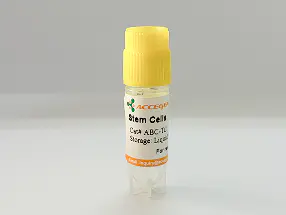
For research use only
| Cat No. | ABC-SC2059 |
| Product Type | Human iPSCs |
| Cell Type | Induced Pluripotent Stem Cell |
| Species | Human |
| Growth Conditions | 37 ℃, 5% CO2 |
| Source Organ | Fibroblast |
| Disease | Werner Syndrome |
| Storage | Liquid Nitrogen |
HighQC™ Human IPSC From Fibroblast-Werner Syndrome provides a disease-relevant iPSC model for studying WRN-linked premature aging and genetic disorders.
HighQC™ Human IPSC From Fibroblast-Werner Syndrome is a disease-specific human induced pluripotent stem cell line derived from dermal fibroblasts of a donor diagnosed with Werner Syndrome, an autosomal recessive progeroid disorder caused by mutations in the Werner RecQ helicase (WRN) gene and characterized by premature aging. The resulting iPSCs (induced pluripotent stem cells) exhibit adherent growth with a high nucleus-to-cytoplasm ratio. The cells retain pluripotency and model Werner-related aging traits. They retain the fundamental capacity for trilineage differentiation into cell types of the ectoderm, mesoderm, and endoderm germ layers. Core pluripotency marker SSEA-4 is expressed. The cells undergo rigorous screening and isolation procedures, and are rigorously tested to ensure they are free of contamination from HIV-1, HBV, HCV, Syphilis, Mycoplasma, Fungi, Yeast, and Bacteria.
| Product Code | HighQC™ Human IPSC From Fibroblast-Werner Syndrome, HighQC™ hiPSC WS, hiPSC-WS, HighQC™ Human Induced Pluripotent Stem Cells From Fibroblast-Werner Syndrome |
| Species | Human |
| Cat.No | ABC-SC2059 |
| Product Category | Stem Cells |
| Size/Quantity | 1 vial |
| Cell Type | Induced Pluripotent Stem Cell |
| Growth Mode | Adherent |
| Shipping Info | Dry Ice |
| Growth Conditions | 37 ℃, 5% CO2 |
| Source Organ | Fibroblast |
| Disease | Werner Syndrome |
| Storage | Liquid Nitrogen |
| Product Type | Human iPSCs |
HighQC™ Human IPSC From Fibroblast-Werner Syndrome serves as a patient-specific model for studying premature aging. Its pluripotent capacity enables directed differentiation into mesenchymal lineages, such as osteoblasts and fibroblasts, facilitating research on accelerated senescence, genomic instability, and tissue degeneration mechanisms. This system is valuable for modeling age-related pathologies in vitro and for screening compounds targeting progeroid pathways.
When you publish your research, please cite our product as "AcceGen Biotech Cat.# XXX-0000". In return, we’ll give you a $200 coupon. Simply click here and submit your paper’s PubMed ID (PMID).