



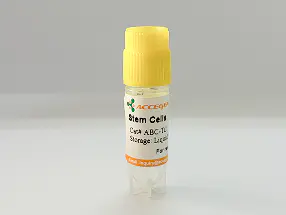
For research use only
| Cat No. | ABC-SC0013T |
| Product Type | Human iPSCs |
| Cell Type | Induced Pluripotent Stem Cell |
| Species | Human |
| Growth Conditions | 37 ℃, 5% CO2 |
| Source Organ | Foreskin |
| Disease | Normal |
| Storage | Liquid Nitrogen |
Explore HighQC™ Human IPSC From Foreskin Fibroblast (Alzheimer’s Disease Patient, PSEN2, N141I) for neurodegeneration modeling and PSEN2 mutation studies.
HighQC™ Human iPSC From Foreskin Fibroblasts (Alzheimer’s Disease Patient, PSEN2, N141I) is an induced pluripotent stem cell derived from foreskin fibroblasts of a donor carrying the PSEN2 N141I mutation linked to early-onset familial Alzheimer’s disease (EOFAD). These cells are generated by transducing four transcription factors, OCT3/4, SOX2, KLF4, and c-MYC, into human foreskin fibroblasts, and are clonally derived and maintained under feeder-free conditions. The resulting iPSC lines retain the disease-relevant PSEN2 N141I mutation. This cell line is designed to exploit the potential of hiPSCs as versatile disease models, providing a reliable tool to study the molecular underpinnings of Alzheimer’s disease progression. The cells undergo rigorous screening and isolation procedures, and are rigorously tested to ensure they are free of contamination from HIV-1, HBV, HCV, syphilis, mycoplasma, fungi, yeast, and bacteria.
| Product Code | HighQC™ Human IPSC From Foreskin Fibroblast (Alzheimer’s Disease Patient, PSEN2, N141I), Human iPSC-Fib-AD-PSEN2, hIPSC-Fib-AD-PSEN2, Human Foreskin Fibroblast Derived iPSC Alzheimer |
| Species | Human |
| Cat.No | ABC-SC0013T |
| Product Category | Stem Cells |
| Size/Quantity | 1 vial |
| Cell Type | Induced Pluripotent Stem Cell |
| Growth Mode | Adherent |
| Shipping Info | Dry Ice |
| Growth Conditions | 37 ℃, 5% CO2 |
| Source Organ | Foreskin |
| Disease | Normal |
| Storage | Liquid Nitrogen |
| Product Type | Human iPSCs |
HighQC™ Human iPSC From Foreskin Fibroblasts (Alzheimer’s Disease Patient, PSEN2, N141I) serve as a disease-relevant in vitro model to study the pathogenesis of familial Alzheimer’s disease (FAD) with PSEN2 mutations. These cells can be differentiated into neuronal subtypes, including cortical neurons, to study aberrant signaling pathways—particularly those involving amyloid precursor protein processing, insulin signaling, and synaptic dysfunction.
When you publish your research, please cite our product as "AcceGen Biotech Cat.# XXX-0000". In return, we’ll give you a $200 coupon. Simply click here and submit your paper’s PubMed ID (PMID).