



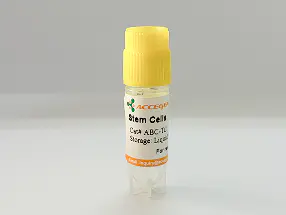
For research use only
| Cat No. | ABC-SC0238 |
| Product Type | Human iPSCs |
| Cell Type | Induced Pluripotent Stem Cell |
| Species | Human |
| Growth Conditions | 37 ℃, 5% CO2 |
| Disease | Spinal Muscular Atrophy I |
| Storage | Liquid Nitrogen |
From Spinal Muscular Atrophy I Donor
HighQC™ Human Induced Pluripotent Stem Cells, From Spinal Muscular Atrophy, are derived from patients with Spinal Muscular Atrophy Type II (SMA) and generated by reprogramming somatic cells using integrating lentiviral vectors encoding a defined set of pluripotency-associated transcription factors, including OCT4, SOX2, NANOG, and LIN28. These iPSCs exhibit characteristic pluripotent stem cell morphology, such as a high nucleus-to-cytoplasm ratio and prominent nucleoli. Each lot undergoes rigorous screening and isolation procedures, and is rigorously tested to ensure it is free of contamination from HIV-1, HBV, HCV, syphilis, mycoplasma, fungi, yeast, and bacteria.
| Product Code | HighQC™ Human Induced Pluripotent Stem Cells, From Spinal Muscular Atrophy I, Human iPSC-SMAI, hIPSC-SMAI, Human Induced Pluripotent Stem Cells SMA |
| Species | Human |
| Cat.No | ABC-SC0238 |
| Product Category | Stem Cells |
| Size/Quantity | 1 vial |
| Cell Type | Induced Pluripotent Stem Cell |
| Growth Mode | Adherent |
| Shipping Info | Dry Ice |
| Growth Conditions | 37 ℃, 5% CO2 |
| Disease | Spinal Muscular Atrophy I |
| Biosafety Level | 1 |
| Storage | Liquid Nitrogen |
| Product Type | Human iPSCs |
HighQC™ Human Induced Pluripotent Stem Cells, From Spinal Muscular Atrophy provide a valuable tool for studying the disease’s mechanisms and developing potential treatments. These cells retain the genetic characteristics of SMA and can differentiate into motor neurons, which are primarily affected in the disease. They are ideal for disease modeling, drug screening, and gene therapy research.
When you publish your research, please cite our product as "AcceGen Biotech Cat.# XXX-0000". In return, we’ll give you a $200 coupon. Simply click here and submit your paper’s PubMed ID (PMID).