



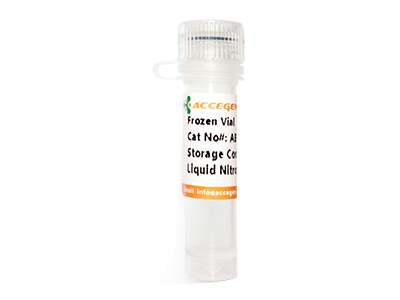
For research use only
| Cat No. | ABC-RC472H |
| Product Type | Reporter Stable Cell Line |
| Cell Type | Epithelial |
| Host Cell | LS-174T Cell Line |
| Source Organ | Large Intestine; Colon |
| Disease | Adenocarcinoma |
| Storage | Liquid Nitrogen |
LS-174T (NFkB) Luciferase Reporter Cell Line ,LS-174T cells stably expressing luciferase; model for NF-κB signaling, cancer biology and drug screening.
The LS-174T (NFkB) Luciferase cell line is transformed from LS-174T cell, expressing the firefly luciferase gene. The cell constitutively express Luciferase.
| Product Code | LS-174T (NFkB) Luciferase Cell Line |
| Cat.No | ABC-RC472H |
| Product Category | Transfected Stable Cell Lines |
| Size/Quantity | 1 vial |
| Cell Type | Epithelial |
| Growth Mode | Adherent |
| Shipping Info | Dry Ice |
| Growth Conditions | 37 ℃, 5% CO2 |
| Source Organ | Large Intestine; Colon |
| Disease | Adenocarcinoma |
| Biosafety Level | 1 |
| Storage | Liquid Nitrogen |
| Product Type | Reporter Stable Cell Line |
| Host Cell | LS-174T Cell Line |
| Stock | In Stock |
| Quality Control | All cells test negative for mycoplasma, bacteria, yeast, and fungi. |
When you publish your research, please cite our product as “AcceGen Biotech Cat.# XXX-0000”. In return, we’ll give you a $200 coupon. Simply click here and submit your paper’s PubMed ID (PMID).
This cell line is a pathway-specific luciferase reporter model designed to monitor activation of the NF-κB signaling pathway. The luminescence signal reflects NF-κB pathway activity rather than constitutive luciferase expression or stable cell number.
As a result, the bioluminescent signal is not directly correlated with tumor burden and may fluctuate depending on pathway activation status. Therefore, this cell line is not recommended for in vivo tumor growth tracking applications where luciferase signal intensity is expected to correlate quantitatively with cell number.
For in vivo bioluminescence imaging of tumor growth, a constitutively luciferase-expressing stable cell line is recommended. Such models provide stable, high-level luciferase expression, allowing reliable detection of luciferin-dependent signals that correlate with tumor cell proliferation and burden.