



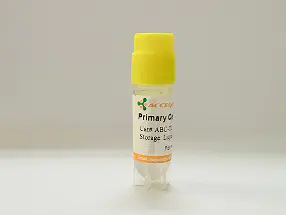
For research use only
| Cat No. | ABC-TC3266 |
| Product Type | Canine Primary Cells |
| Cell Type | Osteoblast |
| Species | Canine |
| Growth Conditions | 37 ℃, 5% CO2 |
| Source Organ | Bone |
| Disease | Normal |
| Storage | Liquid Nitrogen |
Canine Osteoblasts (CnOb) are isolated from canine bone and are cryopreserved at second passage.
Canine Osteoblasts (CnOb) are primary bone-forming cells derived from the long bone tissue of clinically healthy, pathogen-free canines. These cells are isolated through enzymatic digestion and cultured under sterile conditions. CnOb exhibit a polygonal to cuboidal morphology, express osteoblast-specific markers such as alkaline phosphatase and osteocalcin, and demonstrate robust matrix mineralization activity under osteogenic induction, supporting studies on bone density in canines. These cells are negative for bacteria, yeast, fungi, and mycoplasma. Donor animals are screened to ensure no skeletal or metabolic bone disorders. Cells are confirmed negative for common canine viruses including canine parvovirus and distemper virus. To ensure the quality of these primary cells, repeated freeze-thawcycles are not recommended due to the fragile nature of these cells. Each lot undergoes rigorous screening and isolation procedures, and is rigorously tested to ensure it is free of contamination from Mycoplasma, Fungi, Yeast, and Bacteria.
| Product Code | CnOb, Canine Osteoblasts, Osteoblasts |
| Species | Canine |
| Cat.No | ABC-TC3266 |
| Product Category | Primary Cells |
| Size/Quantity | 1 vial |
| Cell Type | Osteoblast |
| Growth Mode | Adherent |
| Shipping Info | Dry Ice |
| Growth Conditions | 37 ℃, 5% CO2 |
| Source Organ | Bone |
| Disease | Normal |
| Biosafety Level | 1 |
| Storage | Liquid Nitrogen |
| Product Type | Canine Primary Cells |
| Quality Control | All cells test negative for mycoplasma, bacteria, yeast, and fungi. |
Canine Osteoblasts offer a physiologically relevant in vitro model for studying osteogenesis, bone remodeling, and metabolic bone disorders in both veterinary and translational research. They are ideal for applications such as evaluating orthopedic implants and biomaterials, testing osteoinductive drugs, and investigating the molecular pathways involved in bone formation, fracture healing, and osteolytic diseases. Their use supports comparative studies of canine and human bone pathophysiology and bone regeneration and repair.
When you publish your research, please cite our product as “AcceGen Biotech Cat.# XXX-0000”. In return, we’ll give you a $200 coupon. Simply click here and submit your paper’s PubMed ID (PMID).