



For research use only
| Cat No. | ABC-TC5589 |
| Product Type | Human Ovarian Cancer Cell Lines |
| Species | Human |
| Growth Conditions | 37 ℃, 5% CO2 |
| Source Organ | Ovary |
| Disease | Ovarian Epithelial Endometroid Cancer |
| Product Code | Cov362; COV-362 |
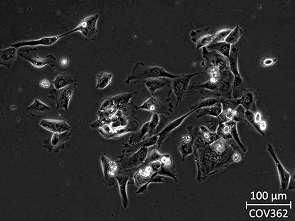
COV362 ovarian carcinoma cells show epithelial morphology, chromosome rearrangements, TP53/BRCA1 mutations, and tumorigenicity in nude mice xenografts.
COV362 is a human ovarian epithelial-endometrioid carcinoma cell line that was derived from pleural effusion of a patient with high‑grade serous ovarian carcinoma (HGSOC). COV362 exhibits epithelial-like morphology with polygonal and fusiform cell shape and adherent culture properties. It demonstrates anchorage-independent growth in soft agar. Cytogenetic profiling demonstrates structural rearrangements in chromosomes 1, 3, 7, and 11. Genetically, COV‑362 harbors TP53 and BRCA1/2 mutations typical of HGSOC, with transcriptomic clustering confirming its similarity to high‑grade serous carcinoma models. Gene expression profiling shows elevated levels of drug‑resistance and estrogen metabolism genes. COV362 maintains tumorigenicity in a nude mouse model and its behavior in these models can be influenced by factors like estrogen. This cell line is particularly valuable for studying the unique biology of HGSOC, including metabolic reprogramming and mechanisms of platinum resistance, making it an essential tool for translational research in gynecologic oncology.
| Product Code | Cov362; COV-362 |
| Species | Human |
| Cat.No | ABC-TC5589 |
| Product Category | Tumor Cell Lines |
| Size/Quantity | 1 vial |
| Growth Mode | Adherent |
| Shipping Info | Dry Ice |
| Growth Conditions | 37 ℃, 5% CO2 |
| Source Organ | Ovary |
| Disease | Ovarian Epithelial Endometroid Cancer |
| Biosafety Level | 2 |
| Storage | Liquid Nitrogen |
| Product Type | Human Ovarian Cancer Cell Lines |
The COV362 cell line finds diverse applications, serving as a valuable tool in the creation of xenograft models for preclinical drug development insights, exploring the impact of estrogen supplementation on ovarian cancer behavior and targeted therapeutic responses. Additionally, it proves crucial in genomic analyses, reflecting the prevalent high-grade serous ovarian cancer (HGSOC) subtype. Moreover, COV362 serves as a robust model for testing potential therapies, including innovative approaches like CAR-T cell therapies.
When you publish your research, please cite our product as “AcceGen Biotech Cat.# XXX-0000”. In return, we’ll give you a $200 coupon. Simply click here and submit your paper’s PubMed ID (PMID).