For research use only
| Cat No. | ABC-TC0160 |
| Product Type | Human Lung Cell Lines |
| Cell Type | Epithelial |
| Species | Human |
| Growth Conditions | 37 ℃, 5% CO2 |
| Source Organ | Lung |
| Disease | Lung Small Cell Cancer |
| Product Code | Colo 668; COLO668; Colo668; Colorado 668 |
Human lung oat cell carcinoma. Derived from a brain metastasis of a 47 year old female with oat cell carcinoma of the lung.
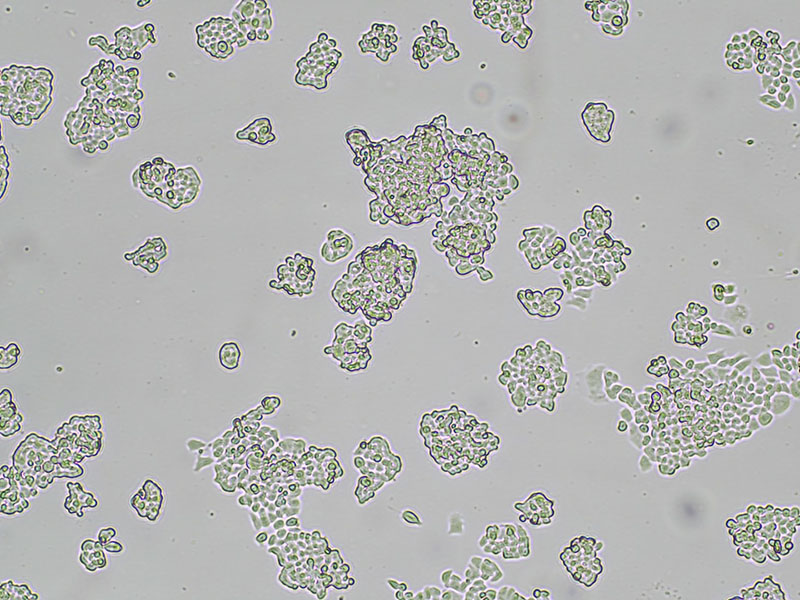
COLO‑668 is a human lung oat cell carcinoma cell line derived from a brain metastasis of a 47‑year‑old female patient. The cells grow predominantly in suspension with occasional loose adherent clusters, and exhibit a polygonal, epithelial‑like morphology. COLO‑668 has a diploid karyotype (2n = 46) and is microsatellite stable (MSS), offering genomic consistency ideal for long‑term studies. It harbors key mutations commonly found in SCLC, including alterations in KRAS, BRAF (V600E), RB1, and TP53, making it suitable for modeling aggressive and treatment‑resistant phenotypes. These cells are known for rapid proliferation and neuroendocrine characteristics typical of high‑grade SCLC, and have been widely used in pharmacogenomics, drug resistance profiling, and in vivo tumorigenicity assays. COLO‑668 provides a reproducible model for translational cancer research. The cells undergo rigorous screening and isolation procedures, and are rigorously tested to ensure they are free of contamination from HIV-1, HBV, HCV, syphilis, mycoplasma, fungi, yeast, and bacteria.
| Product Code | Colo 668; COLO668; Colo668; Colorado 668 |
| Species | Human |
| Cat.No | ABC-TC0160 |
| Product Category | Tumor Cell Lines |
| Size/Quantity | 1 vial |
| Cell Type | Epithelial |
| Growth Mode | Suspension |
| Shipping Info | Dry Ice |
| Growth Conditions | 37 ℃, 5% CO2 |
| Source Organ | Lung |
| Disease | Lung Small Cell Cancer |
| Biosafety Level | 1 |
| Storage | Liquid Nitrogen |
| Product Type | Human Lung Cell Lines |
COLO-668 is widely used as a preclinical model for studying lung carcinoma, particularly in the context of metastasis and chemoresistance. It supports drug screening efforts for platinum-based chemotherapies and targeted inhibitors, as well as functional studies on TP53 and RB1 signaling loss. The cell line is also employed in tumorigenicity experiments, gene expression profiling, and high-throughput pharmacogenomics to explore novel treatment strategies for SCLC.
When you publish your research, please cite our product as “AcceGen Biotech Cat.# XXX-0000”. In return, we’ll give you a $200 coupon. Simply click here and submit your paper’s PubMed ID (PMID).
COLO-668 cells were derived from a metastatic site of a human colorectal adenocarcinoma. They are widely used in cancer research, particularly in studies related to colorectal cancer biology, drug testing, and molecular studies.
The recommended seeding density for COLO-668 cells can vary depending on the specific experimental requirements and growth characteristics of the cells. As a general guideline:
Initial Seeding Density: COLO-668 cells are typically seeded at a density ranging from 1 × 10^5 to 5 × 10^5 cells per milliliter (cells/mL) of medium.
Adherence Considerations: COLO-668 cells are epithelial in origin and generally adhere well to tissue culture vessels. However, certain conditions or issues may affect their adherence:
Cell Health: Ensure that the cells are healthy and not undergoing stress due to factors like incorrect medium composition, pH imbalance, or excessive handling.
Surface Coating: COLO-668 cells may require specific surface coatings (e.g., collagen, fibronectin) to promote adherence. Check if the culture vessel has been properly coated before seeding.
Cell Density: If seeded at too low a density, cells might not adhere well. Try increasing the seeding density slightly or adjusting the incubation time after seeding to allow for attachment.
Cell Passage Number: Higher passage number cells may have reduced adherence properties. Consider using cells from earlier passages if adherence remains an issue.
Medium Composition: Ensure the medium is appropriate for COLO-668 cells and contains necessary supplements for their growth and adherence.
By addressing these factors, you can optimize the conditions for COLO-668 cell culture and promote adherence to the culture vessel surface, ensuring robust growth and experimental success.