



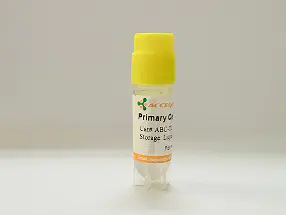
For research use only
| Cat No. | ABC-TC3140 |
| Product Type | Bronchial Cells |
| Cell Type | Epithelial |
| Species | Human |
| Growth Conditions | 37 ℃, 5% CO2 |
| Source Organ | Bronchial |
| Disease | Normal |
| Storage | Liquid Nitrogen |
These cells are isolated from normal donor airway epithelial tissue located above the bifurcation of the lungs.
Human Bronchial Epithelial Cells without RA are primary cells typically isolated from the bronchial mucosa. They consist of basal cells (expressing CK5/CK14, with stem cell properties), goblet cells (secreting mucins such as MUC5AC), and ciliated cells (clearing mucus through ciliary beating). Human Bronchial Epithelial Cells express tight junction proteins (e.g., Occludin, Claudin-3, ZO-1) to maintain epithelial barrier integrity. They can also initiate basic innate defense responses against inhaled pathogens, although mucociliary differentiation is limited without RA. Additionally, these bronchial cells participate in immune responses by secreting cytokines (e.g., IL-8, TNF-α) and expressing pattern recognition receptors (e.g., TLR4). The cells undergo rigorous screening and isolation procedures, and are rigorously tested to ensure they are free of contamination from HIV-1, HBV, HCV, Syphilis, Mycoplasma, Fungi, Yeast, and Bacteria.
| Product Code | Human Bronchial Epithelial Cells without RA,Bronchial Epithelial Cells,Airway Epithelial Cells,HBECs,RA-free HBECs |
| Species | Human |
| Cat.No | ABC-TC3140 |
| Product Category | Primary Cells |
| Size/Quantity | 1 vial |
| Cell Type | Epithelial |
| Growth Mode | Adherent |
| Shipping Info | Dry Ice |
| Growth Conditions | 37 ℃, 5% CO2 |
| Source Organ | Bronchial |
| Disease | Normal |
| Biosafety Level | 1 |
| Storage | Liquid Nitrogen |
| Product Type | Bronchial Cells |
| Quality Control | All cells test negative for mycoplasma, bacteria, yeast, and fungi. |
Human Bronchial Epithelial Cells can be used as an in vitro model to examine how various compounds influence epithelial cell proliferation, differentiation, and functional characteristics. Additionally, these cells can be used to simulate the respiratory microenvironment, enabling the study of pathogen infection and inflammatory response processes.
When you publish your research, please cite our product as “AcceGen Biotech Cat.# XXX-0000”. In return, we’ll give you a $200 coupon. Simply click here and submit your paper’s PubMed ID (PMID).