- In-Stock Tumor Cell Lines
- Human Orbital Fibroblasts
- Human Microglia
- Human Pulmonary Alveolar Epithelial Cells
- Human Colonic Fibroblasts
- Human Type II Alveolar Epithelial Cells
- Human Valvular Interstitial Cells
- Human Thyroid Epithelial Cells
- C57BL/6 Mouse Dermal Fibroblasts
- Human Alveolar Macrophages
- Human Dermal Fibroblasts, Adult
- Human Lung Fibroblasts, Adult
- Human Retinal Muller Cells
- Human Articular Chondrocytes
- Human Retinal Pigment Epithelial Cells
- Human Pancreatic Islets of Langerhans Cells
- Human Kidney Podocyte Cells
- Human Renal Proximal Tubule Cells
Start with what you actually need
Most people overcomplicate cell model selection at the beginning. In practice, the question is usually simpler: are you trying to obtain a clear, reproducible signal, or are you aiming to mimic real biological behavior as closely as possible?
If you don’t separate these two goals early on, you can easily either overdesign your experiment or end up with data that’s hard to trust.
Why most projects still start with cell lines
There’s a reason cell lines remain widely used. They are stable, scalable, and relatively easy to control. For early-stage work—such as testing whether a pathway responds or whether a target is worth pursuing—they are often the fastest way to obtain a clear result.
Using standardized, well-characterized cell lines (for example from suppliers like AcceGen) also helps reduce variability caused by long-term culture or inconsistent handling, a common quiet struggle in many labs.
That said, cell lines are typically just a starting point, not the final answer.
Why primary cells are often where the real data comes from
This is the point many researchers realize only later: Once you move beyond initial screening, cell lines often lose their persuasiveness.
Primary cells tend to behave in ways that are less “clean,” but much closer to real biological systems. For applications like immunology, inflammation, toxicity testing, or any study involving cell-specific function, this difference is hard to ignore. Results that look strong in cell lines can weaken—or even disappear—once tested in primary cells.
For this reason, many researchers now treat primary cells not as an optional upgrade, but as a necessary step for generating data that can actually hold up, especially in publications or downstream applications.
Naturally, they come with challenges: variability, a shorter lifespan, and more sensitive culture conditions. In practice, however, much of this risk can be managed by using well-characterized, quality-controlled primary cell products. Working with reliable sources such as AcceGen can make primary cell experiments much more consistent and reduce the uncertainty that people often associate with them.
In other words: if your results need to be taken seriously, primary cells are often not optional.
What people actually do in real projects
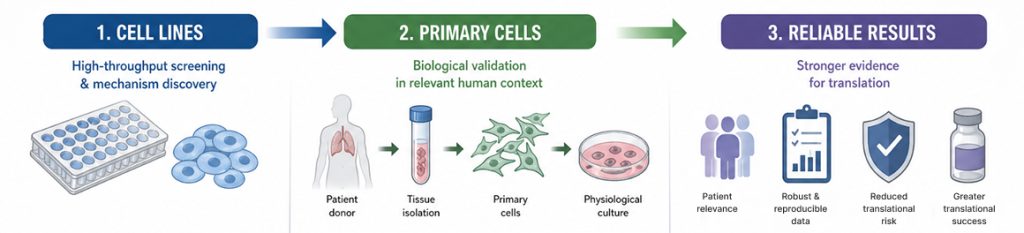
In reality, most projects don’t rely on a single model. A more practical approach is to use them in sequence.
Start with cell lines to get a fast, controlled readout. Then move to primary cells to confirm whether those findings still make sense in a more realistic biological context. This step is often where the most important insights—or problems—show up.
Skipping this transition is one of the most common reasons results fail to translate.
Final thought
If there’s one takeaway, it’s this: cell lines help you move fast, but primary cells help you move forward.
Using both is often the most efficient strategy—and if you must prioritize where your data becomes truly meaningful, it is usually at the stage where primary cells are used.

Copyright - Unless otherwise stated all contents of this website are AcceGen™ All Rights Reserved – Full details of the use of materials on this site please refer to AcceGen Editorial Policy – Guest Posts are welcome, by submitting a guest post to AcceGen you are agree to the AcceGen Guest Post Agreement – Any concerns please contact marketing@accegen.com