



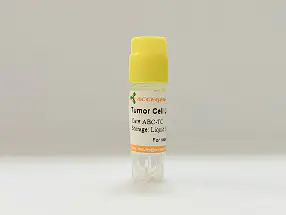
Tumor Cell Lines

Calu-1

  • For research use only

Cat No.

ABC-TC0110

Product Type

Human Lung Cancer Cell Lines

Cell Type

Epithelial

Species

Human

Growth Conditions

37 ℃, 5% CO2

Source Organ

Lung

Disease

Lung Cancer

Product Code

CaLu-1; CALU-1; Calu.1; CALU 1; Calu 1; CALU1; Calu1

The Calu-1 cell line is a human lung carcinoma model used for cancer research, signaling pathway studies, and drug screening assays in vitro.

Product Image

Description

Calu-1 is a human non-small cell lung carcinoma (NSCLC) line derived in 1971 from a pleural metastasis in a 47-year-old Caucasian male with grade III epidermoid carcinoma of the lung. These cells grow adherently with an epithelial, polygonal morphology and feature pronounced microvilli, abundant rough endoplasmic reticulum, lysosomes, and lipid inclusions. They exhibit a moderate growth rate, which supports reproducible in vitro proliferation studies. Genetically, Calu-1 expresses wild-type STK11 (also known as LKB1) and EGFR, harbors a KRAS p.G12C oncogenic mutation, and lacks functional p53 and FHIT tumor suppressors due to homozygous deletions. Functional studies reveal Calu-1 has active voltage-gated sodium channels linked to enhanced migration and invasiveness. Together, these characteristics make Calu-1 a robust NSCLC model, especially for studying KRAS-driven tumor behaviors and epithelial features. The cells undergo rigorous screening and isolation procedures, and are rigorously tested to ensure they are free of contamination from HIV-1, HBV, HCV, Syphilis, Mycoplasma, Fungi, Yeast, and Bacteria.

Product Code

CaLu-1; CALU-1; Calu.1; CALU 1; Calu 1; CALU1; Calu1

Species

Human

Cat.No

ABC-TC0110

Product Category

Tumor Cell Lines

Size/Quantity

1 vial

Cell Type

Epithelial

Growth Mode

Adherent

Shipping Info

Dry Ice

Growth Conditions

37 ℃, 5% CO2

Source Organ

Lung

Disease

Lung Cancer

Biosafety Level

1

Storage

Liquid Nitrogen

Product Type

Human Lung Cancer Cell Lines

Application

  • Calu-1 serves as a valuable in vitro and in vivo model for investigating KRAS p.G12C-driven lung cancer mechanisms, particularly in squamous cell carcinoma contexts. Its intrinsic resistance to EGFR-targeted therapies like erlotinib enables studies into drug resistance pathways. Invasion assays, including 3D co-culture with fibroblasts, demonstrate a high epithelial-to-mesenchymal transition (EMT) signature and collective-to-single cell invasive transition—making Calu-1 particularly suited for metastasis and tumor-stroma interaction studies. The functional sodium channel activity also supports research into bioelectric signaling in cancer progression and potential ion channel-targeted therapeutic strategies.

Citation

When you publish your research, please cite our product as “AcceGen Biotech Cat.# XXX-0000”. In return, we’ll give you a $200 coupon. Simply click here and submit your paper’s PubMed ID (PMID).

Inquiring Calu-1

We know how valuable your research is to you, but are you wondering what you can expect to pay for quick accurate results every time? Fill out a request in the form below and we’ll get back to you within 24 hours with a quote.
High Viability
To succeed in cell culture
Precision and Reliability
To support a consistent result
Customization Options
Tailed to your research

Tags

AcceGen Scroll Top Button