



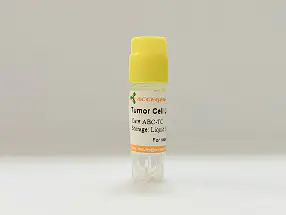
For research use only
| Cat No. | ABC-TC0146 |
| Product Type | Human Leukemia Cell Lines |
| Cell Type | T Cell |
| Species | Human |
| Growth Conditions | 37 ℃, 5% CO2 |
| Source Organ | Peripheral Blood |
| Disease | Chronic Myeloid Leukemia |
| Product Code | CML T1; CMLT-1; CMLT1 |
Cells were described to express T cell surface markers and to carry the BCR-ABL1 translocation e13-a2 (b2-a2) producing the p210 BCR-ABL protein
CML‑T1 is a human T‑lymphoid cell line established from the acute phase of Ph‑negative chronic myelogenous leukemia (CML) in a 36‑year‑old female patient. These cells grow in suspension with lymphoblast morphology and express T‑cell markers confirmed by cytochemical reactivity and TCRβ gene rearrangement. Cytogenetically, CML‑T1 harbors a BCR‑ABL1 fusion transcript (e13‑a2/b2‑a2) encoding the p210 oncoprotein—characteristic of CML pathology, despite lacking the classical Philadelphia chromosome. Molecular characterization has confirmed BCR‑ABL1 expression and T‑cell lineage identity. The cells undergo rigorous screening and isolation procedures, and are rigorously tested to ensure they are free of contamination from HIV-1, HBV, HCV, syphilis, mycoplasma, fungi, yeast, and bacteria.
| Product Code | CML T1; CMLT-1; CMLT1 |
| Species | Human |
| Cat.No | ABC-TC0146 |
| Product Category | Tumor Cell Lines |
| Size/Quantity | 1 vial |
| Cell Type | T Cell |
| Growth Mode | Suspension |
| Shipping Info | Dry Ice |
| Growth Conditions | 37 ℃, 5% CO2 |
| Source Organ | Peripheral Blood |
| Disease | Chronic Myeloid Leukemia |
| Biosafety Level | 1 |
| Storage | Liquid Nitrogen |
| Product Type | Human Leukemia Cell Lines |
CML‑T1 serves as a critical model for elucidating mechanisms of BCR‑ABL1–driven leukemogenesis, especially in Philadelphia‑negative CML cases. Its T‑cell origin and BCR‑ABL1 fusion allow for high-throughput studies on tyrosine kinase inhibitor response and resistance, including de novo mutation acquisition under imatinib. As CML‑T1 exhibits activation of DNA repair enzymes like LIG1, PARP1, and UNG, it’s well-suited for investigating error-prone repair pathways. The cell line supports drug screening, resistance modeling, and signal transduction analysis in CML and lymphoid blast crisis contexts.
When you publish your research, please cite our product as “AcceGen Biotech Cat.# XXX-0000”. In return, we’ll give you a $200 coupon. Simply click here and submit your paper’s PubMed ID (PMID).