



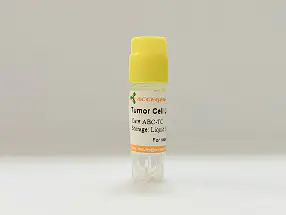
For research use only
| Cat No. | ABC-TC0284 |
| Product Type | Human Lung Cancer Cell Lines |
| Cell Type | Epithelial |
| Species | Human |
| Growth Conditions | 37 ℃, 5% CO2 |
| Source Organ | Lung |
| Disease | Lung Small Cell Cancer |
| Product Code | H69v; MOG-H69V |
Human lung small cell carcinoma. An adherent subline H69v was derived from the cell line H69
H69V is an adherent subclone derived from the parental H69 small cell lung carcinoma cell line. Unlike H69, H69V attaches to the culture surface and grows in monolayers, although it retains many of the neuroendocrine characteristics of small cell lung carcinoma. The cell line is aneuploid and suitable for studies involving epithelial-mesenchymal transition and differentiation. H69V is tumorigenic in xenograft models. The cells undergo rigorous screening and isolation procedures, and are rigorously tested to ensure they are free of contamination from HIV-1, HBV, HCV, Syphilis, Mycoplasma, Fungi, Yeast, and Bacteria.
| Product Code | H69v; MOG-H69V |
| Species | Human |
| Cat.No | ABC-TC0284 |
| Product Category | Tumor Cell Lines |
| Size/Quantity | 1 vial |
| Cell Type | Epithelial |
| Growth Mode | Adherent |
| Shipping Info | Dry Ice |
| Growth Conditions | 37 ℃, 5% CO2 |
| Source Organ | Lung |
| Disease | Lung Small Cell Cancer |
| Biosafety Level | 1 |
| Storage | Liquid Nitrogen |
| Product Type | Human Lung Cancer Cell Lines |
H69V cell line is commonly used in advanced studies of small cell lung cancer and its adaptive responses to therapy. They provide insights into mechanisms of drug resistance, epithelial-to-mesenchymal transition, and tumor relapse. Their ability to form tumor spheroids and maintain key neuroendocrine markers makes them valuable for in vitro tumor modeling and drug development.
When you publish your research, please cite our product as “AcceGen Biotech Cat.# XXX-0000”. In return, we’ll give you a $200 coupon. Simply click here and submit your paper’s PubMed ID (PMID).